“I did this because I
am convinced that human life is sacred, and that no one would have
benefited from the death of my neighbors. I did not protect them
because I am a Tutsi or a Hutu. I did it because morality
obligated me to act. We are created by the same God.”
Rebecca Hatungimana
|
1993
|
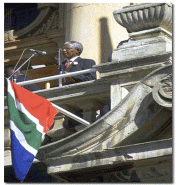
Nelson Mandela is released from jail in 1990, after serving 30 years for his opposition to apartheid and commitment to equal rights for all South Africans. He receives the Nobel Peace Prize in 1993 and on May 10, 1994, he is elected the first Black president of South Africa. |
1997
|
So what's next? Will the new Millennium be a time of peace? How will YOU be a part of the way of nonviolence?
What's your piece of the TimePeace? |
|
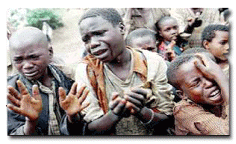
During the Rwandan Genocide in which an estimated 800,000 Hutus and moderate Tutsi are killed, the Tutsi woman Rebecca Hatungimana hides 41 Hutu neighbors in her home, defending them when mobs arrive armed with spears and machetes. Her husband risks his life by protecting the neighbors’ homes and cattle; her children lead them to their fields at night so they can cultivate them, and then back to Rebecca’s for safety. |
1990-1994
|
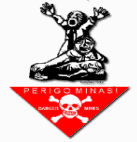
The International Campaign to Ban Landmines receives the Nobel Peace Prize for its efforts to eliminate these weapons that kill and injure long after the "end" of the wars in which they are used. |
primoris
| |
TimePeace - An Interactive Chronograph | |
||||||||
|
||||||||||
|
|
||||||||||
|
|
||||||||||
|
|
||||||||||
"If
people were to consider the states of others as they consider their
own,
then who would raise up their state to attack the state of another?
It would be like attacking their own."
Mo-zi, Universal Love
|
1350 BCE
|
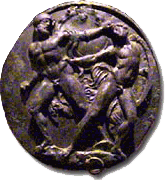
The ancient Olympic truce begins as a month-long "Holy Treaty" between king Iphitor of Elis, king Lykourgos of Sparta, and king Kleosthenes of Pisa. The terms of the truce, engraved on a bronze discus, are: neither armies nor weapons are allowed to enter Elis, attendees whose city-state are at war can travel safely through hostile areas, and no death penalties are allowed. Although the Games last for five days, the month-long truce is later extended two to three months. |
470-390 BCE
|
|
Hebrew midwives Shiprah and Puah commit the first recorded act of civil disobedience by refusing to carry out Pharaoh’s order to kill Hebrew babies in Egypt. |
824 BCE |
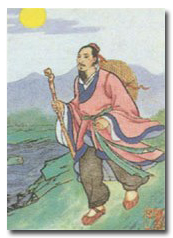
The pacifism of the great Chinese philosopher Mozi leads him and his followers to travel from one crisis zone to another through the ravaged landscape of the Warring States, trying to dissuade rulers from their plans of conquest. According to the chapter "Gongshu" in Mozi, he once walked for ten days to the state of Chu in order to forestall an attack on the state of Song. |

|
1644 |
William Penn’s (unconfirmed) Letter to the Delaware Indians (Leni Lenape) at Shackamaxon leads to treaties that keep peace for 70 years. |
1775-76 |
|
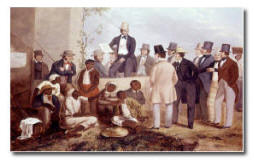
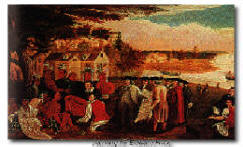
Eleven enslaved African men petition the local government of New Amsterdam (now New York) and obtain their freedom in exchange for the promise to pay an annual tax in produce. Each is granted title to land on the outskirts of the colony. |
1682 |
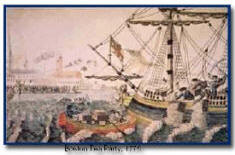
American colonists mount three nonviolent resistance campaigns against British rule (the Stamp Acts of 1765, the Townshend Acts of 1767, and the Coercive Acts of 1774) in which colonists refuse to pay taxes, dump tea in Boston's harbor, and refuse to serve as jurors under British-controlled judges. These actions among others result in a condition of de facto independence by 1775 even before war is declared. |
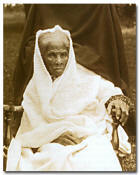
"Every great dream begins with a dreamer. Always remember, you have within you the strength, the patience, and the passion to reach for the stars to change the world."
Harriet Tubman
|
1840s |
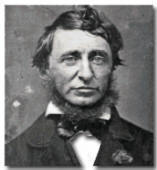
Henry David Thoreau goes to jail for refusing to pay taxes to support the Mexican-American War and the extension of slavery. As a result, he delivers a Concord Lyceum lecture entitled "Civil Disobedience" on January 26, 1848 which leads to the essay that influences Tolstoy, Gandhi, and King. |
1848 |
|
The Underground Railroad helps southern slaves escape to the northern United States or Canada led by “conductors” such as Harriet Tubman. The woman known as "Moses" escapes to freedom in 1849 but returns to lead approximately 300 people to safety. According to one estimate, the South loses 100,000 slaves between 1810 and 1850. |
1846 |
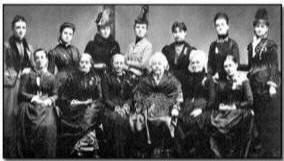
Lucretia Mott and Elizabeth Cady Stanton organize the first women’s rights convention in the United States at Seneca Falls, New York. This meeting produces a series of resolutions demanding increased rights for women, such as opportunities for education and employment and the right to vote. |
|
1850
|
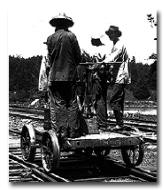
2000 Chinese railroad workers stage a strike protesting poor treatment and low wages. Though they are forced to return to work in a week, their quiet nonviolent action impresses Central Pacific railroad executive Charles Crocker. |
|
|
1870
|
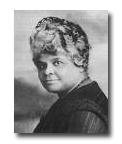
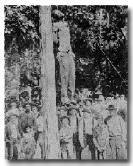
Following the murder of three friends, Ida B. Wells-Barnett starts her lifelong anti-lynching campaign by writing in her newspaper Memphis Free Speech. Forced to move to Chicago, she continues her journalistic attacks on Southern injustices, being especially active in investigating and exposing the fraudulent "reasons" given to lynch African-American men. |
|
|
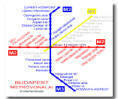
Assisted by the leading writers and intellectuals in Hungary, Ferenc (Francis) Deak urges the Magyars to fight for their freedom from Austria through peaceful, passive resistance. Vienna offers some concessions, but Deak and the other leaders insist on complete acceptance of the April 1848 constitution, eventually securing self-governance. The subway terminal in Budapest is named after him. |
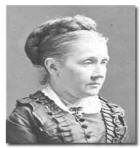
Famous for her poem "The Battle Hymn of the Republic," Julia Ward Howe, distressed by her experience of the Civil War, calls for women to rise up and oppose war in all its forms. Her Mother's Day of Peace, thanks to the efforts of Anna Jarvis, becomes a national holiday in 1914. |
1892
|
|
1867 |
Mahatma Gandhi, Satyagraha Leaflet No. 13, May 3, 1919
|
1900-1905 |
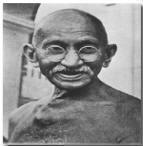
Mohandas Gandhi leads millions of Indians in their struggle for independence from British colonial rule through nonviolent non-cooperation, such as tax resistance, boycotts, and the 1930 nonviolent raid on the Dharasana salt works. |
1930s |
|
On February 15, 1900, the Russian Tsar issues a manifesto forcing Finnish conscripts into the Russian army. Leo Mechelin and others call for resistance and people are urged to refuse support for the new law. Students ski across Finland, collecting signatures as a protest. While the tsar rejects the petition, continued refusal to accept the conscription law results in it not being enforced. In 1905, the tsar issues a proclamation rescinding the February Manifesto. |
1919-1947
|
In Afghanistan, Abdul Ghaffar Khan, a close associate of Gandhi, forms a 100,000 strong peace army of men and women called Khudai Khidmatgar (Servants of God). Rejecting the Pathan tradition of revenge and blood feuds, they are sworn to nonviolence. The Khudai Khidmatgar build schools, institute village development projects, and oppose British colonialism. |
|
1940-45 |
Similar resistance in Norway undermines Nazi plans when teachers refuse to teach Nazi propaganda. All Bulgarian Jews are saved from Nazi death camps from the combined efforts of the king, the Orthodox Church, and the Bulgarian society. |
1942 |
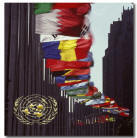
The United Nations is founded to resolve disputes before they result in war. Since then, the UN has developed agencies and programs on arms control, human rights, the environment, hunger, peacekeeping, development, indigenous peoples, refugees, children and women, to name a few. |
|
Finland saves all but 6 of its Jewish citizens from death camps through nonmilitary means. 6,500 of 7,000 Danish Jews escape to Sweden, most of the rest are hidden, aided by the people. A rail worker strike in Holland almost shuts down traffic from 1944 until liberation in 1945, despite extreme difficulties for the people. |
|
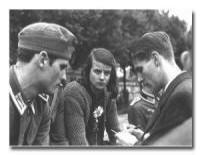
German students form the White Rose resistance movement against the Nazi regime, distributing thousands of leaflets exposing the nature of the Nazis and its treatment of Jews. They urge the “destruction of the war machine by passive resistance,” including sabotage. Several of its leaders are killed in 1943. |
1945
|
Rosa Parks
|
1957 |
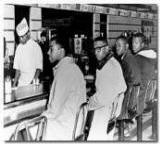
Four black students “sit in” at a whites-only Woolworth lunch counter in Greensboro, North Carolina. The nonviolent tactic of sit-ins spreads in campaigns to desegregate rest rooms, movie theaters, restaurants and libraries. |
1961 |
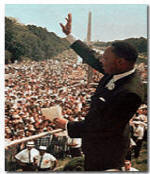
March on Washington is the largest demonstration to date, bringing more than 250, 000 people to the Lincoln Memorial; Dr. Martin Luther King gives his “I have a Dream” speech. |
1965 |
|
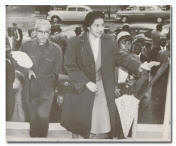
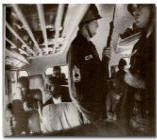
Rosa Parks is arrested after refusing to give up her seat and move to the back of the bus. The black community launches the Montgomery bus boycott. After a year of hardship the boycott succeeds, revitalizing the U.S. civil rights struggle. |
1960 |
Young Freedom Riders protest discrimination on buses; a bus is burned in Alabama, riders are attacked in Birmingham and spend 40-60 days in jail in Jackson, Mississippi. Six months later, the Interstate Commerce Commission bans segregation. |
1963
|
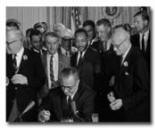
Because of the enthusiasm and activism of many African-American activists, the Voting Rights Act of 1965 is passed by Congress. |
|
1965 |
60,000 join Peace People demonstrations in Belfast and Dublin, the largest nonviolent demonstrations in the history of Northern Ireland. Mairead Corrigan and Betty Williams receive the Nobel Peace Prize for their efforts in nonviolent reconciliation. |
1977 |
|
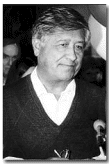
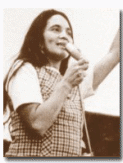
Using nonviolent tactics, Cesar Chavez and Dolores Huerta, the co-founders of the United Farm Workers Union (UFW), organize a successful five year boycott of California table grapes. Eventually, the entire California table grape industry signs a three-year collective bargaining agreement with the UFW. |
1976 |
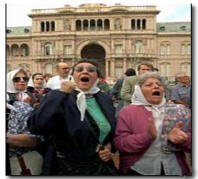
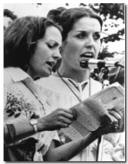
Las Madres de Plaza de Mayo (Mothers of the May Square) buy a newspaper ad in Argentina to publish the names of mothers and pictures of 230 “disappeared;” family members kidnapped, tortured and/or killed by the military. Still active, the mothers continue to meet in the May Square in Buenos Aires every Thursday afternoon. |
"A society still needs idealists;
people who are willing to sacrifice themselves to uphold the basic ideals of freedom and democracy."
Chinese student leader Dan Wang in 1995.
|
1980 |
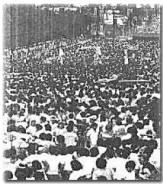
In the Philippines, millions take to the streets in the nonviolent People Power movement that brings down the oppressive Marcos dictatorship. |
1989 |
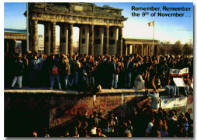
Hungary, Poland, Czechoslovakia, Bulgaria and East Germany all win freedom from Soviet control by nonviolent means. Nonviolent independence movements within the soviet Union are launched in Latvia, Lithuania, Estonia, Georgia, Armenia, Moldavia and the Ukraine. |
|
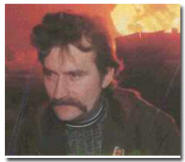
The independent trade union Solidarnosc (Solidarity) is founded by Lech Walesa and others in Poland. In 1981, the movement is repressed under martial law and declared dead by Western correspondents. In 1989, it wins every available seat in Parliament to govern the nation without committing a single violent act. |
1986 |
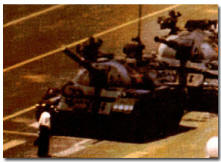
The Chinese government crushes a nonviolent student protest at Tiananmen Square, but not before images are televised around the world, such as an unarmed young man stopping a column of tanks. |
1989 |

Credits:
Wall of Hope from the Lutheran Peace Fellowship, Seattle, WA(http://www.members.tripod.com/~lutheran_peace/wallhopetext.htm) data
The Great Peace March from the PeaceCENTER, San Antonio, TX (www.salsa.net/peace/timeline.net) downloadable word doc with images and info.
Highlights in Peace and War History by Nancy Knowles (http://www.eou.edu/~nknowles/peacehistory.html) data
Chronology of Peacemaking by Sanderson Beck (http://san.beck.org/GPJ-Chronology.html) large, comprehensive data base of peacemakers.
New Internationalist August 2005 Issue 381 The Power of the People (http://www.newint.org/features/2005/08/01/power/) data
Famous Pacifists at Better World Links (http://www.betterworldlinks.org/book10b.htm) data
Pacifist Authors at Thinkexist.com (http://en.thinkexist.com/by/curiosity/by_political_conviction/pacifists/) data and quotes
Random Chapters in the History of Nonviolence by Michael Westmoreland-White at http://www.ecapc.org/articles/WestmoW_2002.08.25.asp data
Nonviolent Sanctions vol. 3, no. 1 Summer 1991 a publication of the Albert Einstein Institution http://65.109.42.80/organizations02c1.html data
International Fellowship of Reconciliation (http://www.ifor.org/timeline.htm) data
Wikipedia (http://en.wikipedia.org/wiki/Main_Page) all data has been cross-referenced with a host of other sources.
Disclaimer:
TimePeace contains but a few excerpts from peacemaking history. More extensive timelines and information can be found at the links above. Great care has been taken in confirming data and in acknowledging sources. Please inform us of mistakes or lack of credit. Blessings and Shalom. The PeaceWizard